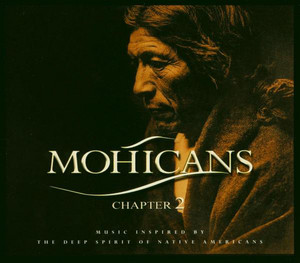
Mohicans
The Mahican ( or Mohican ) are an Eastern Algonquian Native American tribe that was Algonquian-speaking. As part of the Algonquian family of tribes, they were related to the abutting Lenape, who occupied territory to the south as far as the Atlantic coast. The Mahican occupied the upper Hudson River Valley (around the confluence of the Mohawk River, where present-day Albany, New York developed) and into western New England centered on present-day Pittsfield, Massachusetts and lower Vermont. After 1680, due to conflicts with the Mohawk during the Beaver Wars, many were driven southeastward across the present-day Massachusetts western border and the Berkshires to Berkshire County around Stockbridge, Massachusetts.
Since the forcible relocation of Native American populations to reservations in the American west during the 1830s, most descendants of the Mahican are located in Shawano County, Wisconsin. Decades later they eventually formed the federally recognized Stockbridge-Munsee Community with registered members of the Leni Lenape people and have a 22,000-acre (89 km2) reservation.
Following the disruption of the American Revolutionary War, most of the Mahican descendants first migrated westward to join the Iroquois Oneida on their reservation in central New York. The Oneida gave them about 22,000 acres for their use. After more than two decades, in the 1820s and 1830s, the Oneida and the Stockbridge moved again, pressured to relocate to northeastern Wisconsin under the federal Indian Removal program.The tribe identified by the place where they lived: "Muh-he-ka-neew" (or "People of the continually flowing waters.") The word Muh-he-kan refers to a great sea or body of water, and the Hudson River reminded them of their place of origin, so they named the Hudson River "Seepow Mahecaniittuck," or the river where there are people from the continually flowing waters. Therefore, they, along with other tribes living along the Hudson River (such as the Munsee (known by the dialect of Lenape that they spoke) and Wappinger), were called "the River Indians" by the Dutch and English. The Dutch heard and wrote the term for the people of the area variously as: Mahigan, Mahikander, Mahinganak, Maikan and Mawhickon, which the English simplified later to Mahican or Mohican, in a transliteration to their spelling system. The French, adopting names used by their Indian allies in Canada, knew the Mahican as the Loups (or wolves); similarly, they referred to the Iroquois as the "Snake People" (or "Five Nations"). Like the Munsee and Wappinger peoples, the Mahican were related distantly to the Lenape people, who occupied coastal areas from western Connecticut and western Long Island to the Delaware River valley to the south.
In the late twentieth century, the Mahican joined other former New York tribes and the Oneida in filing land claims against New York state for what were considered unconstitutional purchases after the Revolutionary War. In 2010, outgoing governor David Paterson announced a land exchange with the Stockbridge-Munsee that would enable them to build a large casino on 330 acres (130 ha) in Sullivan County in the Catskills, in exchange for dropping their larger claim in Madison County. The deal had many opponents.
Similar Artists